SISSOM: Society for the Improvement of Seventeenth South Of Market

The stretch of 17th Street that runs south of Market St until it crosses Leary, hits Ballard Ave and terminates on Shilshole must be strategically pedestrianized in order to link the current business centers of Market St and Ballard Ave on their eastern ends and ensure an overall connectedness for pedestrian access as we start to develop Ballard east of 15th.

The future of the street needs to start at a central point and spread: the current intersection of 17th, 52nd, Tallman, and Ione. This is a unique intersection as diagonal streets meet grid-oriented streets. Currently there is an island that serves as a traffic barrier and pedestrian stopping point, but it is a poor setup and leads to constant confusion for cars and pedestrians both as they try to cross the extra wide street where traffic approaches from 6 different directions.
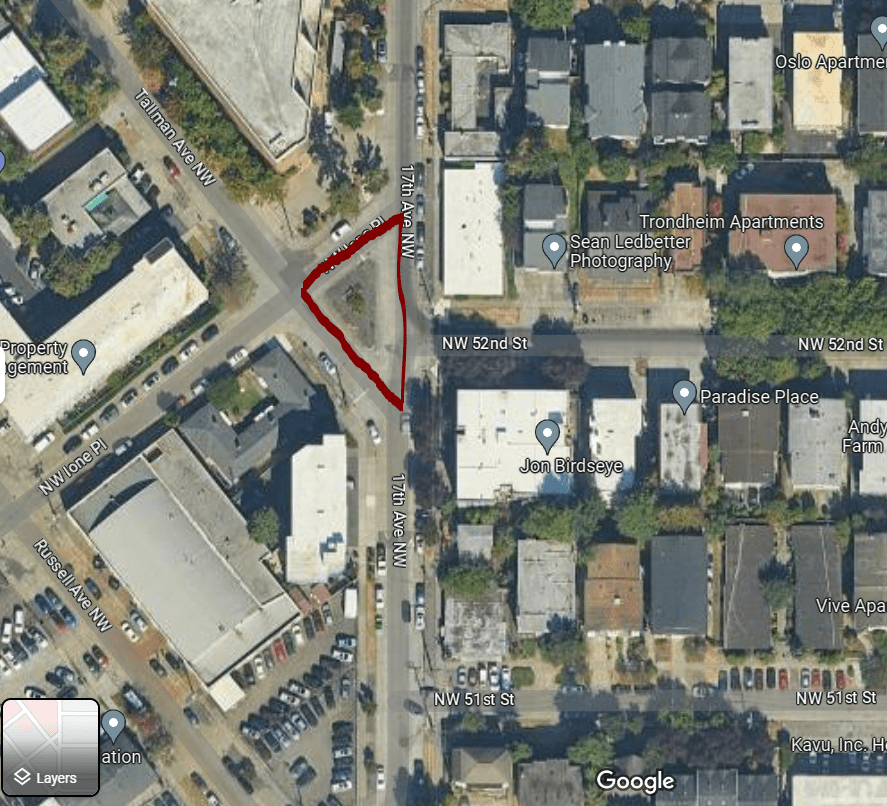
Satellite view of the intersection, outlined in red

The first idea that came to me is changing it to a roundabout. The small segments of Ione and Tallman that are adjacent to the current island would be turned into one-ways going South, and the stretch of 17th that runs along its eastside would be the same but going Northbound. We could reduce the width of the road in multiple spaces (reducing the distance pedestrians are walking in a shared space with autos), eliminate 2 oddly placed and inconvenient parking spots, and improve the flow of car traffic.

Tallman and Ione

The intersection where these two streets meet is currently a huge headache for auto traffic, and the uncertainty this creates in driver behavior makes it a concerning intersection for pedestrians to cross as well. Car drivers seem to have a difficult time understanding who has right of way at this intersection as there are no stop signs or markings. Trying to go North on 17th from here requires a left turn at either the north or south end of the island, but because they intersect the other streets diagonally the driver’s view is obstructed compared to a perpendicular intersection.

Turning it into a one-way roundabout removes all decision-making on the driver’s part and creates a clear, logical path for auto traffic. Pedestrians would have to only look at cars coming from a single direction when crossing rather than 6 directions as it currently stands. It would allow the small sections of road on Ione and Tallman to go from 3 lanes (one parking and two car traffic lanes, one headed each direction) to a single lane (one direction car traffic, no parking) and only remove 2 car parking spots.

While this is done, the adjacent sidewalks would also be expanded so that more trees and plants could be placed in the area. While Tallman is heavily treed leading up to the intersection, they stop suddenly here and leave a large gap where the sun bakes the asphalt during the summer and creates a heat island. This is one factor that reduces the foot traffic coming down 17th from Market.

Ideally this would also include the redevelopment of the apartments on the east side of 17th between 53rd and 52nd as well as the buildings on the corner of 17th and 51st. Those are immediate candidates for spaces that could be built up vertically to increase residential capacity and also use the ground floor for commercial/public spaces so that the “life” on the street extends out from Market.

Other Considerations

There are 3 main businesses/groups that move large vehicles through this area that we do have to accommodate in the design: Swedish Hospital (loading dock is directly adjacent), Dirt Exchange on 50th, and the Fire Department.

Karsti Apartments: Fighting Against their Setting Instead of Embracing it

Karsti Apartments are located in Ballard on the Southwest side of 15th St and NW 59th. The building borders the sidewalk on 15th for about 100 feet. There is a huge amount of auto and a significant amount of pedestrian traffic that moves along this street everyday as 15th is the main N-S arterial in Northwest Seattle.

While they do have a barber shop on the very corner, the rest appears to be residential but it is designed to hide from the street entirely instead of interacting with it. The windows are covered with printed graphics or blinds and the floor is raised from the sidewalk rather than at level. There is no visual exchange between the two spaces, the inside is designed to shield the occupants from the outside as much as possible.

The volume of traffic on the street is a defining trait that is not going to change anytime in the near future. Any building that goes up along said street should be required to be designed so that it interacts with it and views it’s traits as an advantage and embraces them. A building that is designed so that it is fighting against the very nature of its setting will never be a good use of space. It leads to dead zones on streets. It takes space from people and organizations that could actually benefit from the traffic that the builders are trying to shield the occupants from.

Many of the new developments on 15th north of here suffer from this same defect. There are hundreds of residential units with front doors that open directly onto 15th. The townhomes and similar units with front doors that open onto a high-traffic arterial are building types that should have been built a block or two in from 15th. 15th itself should have commercial/public use units on the ground level that would benefit from the passing traffic instead of being negatively impacted by it with higher density apartment units above that could utilize the major bus routes that run along the street. We’re scared to build real density and end up building bad structures that don’t serve any purpose well. These end up doing damage in the long run not only because of the opportunity cost (poor uses of space in important areas), but also because they create a negative perception of what sort of “urban living” proponents are actually trying to create.

Walking in Traffic: Sidewalk Distance from Auto Traffic

For walking to become a viable choice for getting around the city, the experience has to be significantly improved. Walking near automobile traffic is inherently unpleasant to humans, especially when the traffic is consistent and moving at high speeds.

As a general rule, pedestrian walkways should never be placed directly next to a road designed for automobile traffic.

Current research is lacking. Few studies have been done that measure real-time physiological responses in real-world conditions. Those that have used various combinations of heart-rate monitoring, ***, and electrodermal monitoring (EDM). EDM is a measurement of how electro conductive skin is; this measurement is regarded as a strong indicator of stress as the pores on the skin open subconsciously and produce sweat in response to stressor conditions.

Has any field research been done to measure the physical effects of walking near traffic? Does it elevate stress hormones (I.e. cortisol) or other chemicals that have negative effects on our well being? Can we determine if it is based on a measurable factor like sound volume (decibels)? What about the impact visually of a large machine moving quickly while close to you? We need evidence and statistics to be able to show planners that there is a minimum separation needed as well as a need for other mitigating tools like sound reflecting walls, vegetation, quieting pavement, and whatever else we can develop to negate the impact of auto traffic.

Separately, we have to recognize that we can only mitigate the negative effects of auto traffic on pedestrians to a degree and so to have a truly pedestrian space, we have to remove auto traffic entirely. For the last 75 years we have built our cities under the belief that automobile traffic had to be able to reach every single nook and cranny. We have streets with no sidewalks aka no pedestrian access, but we have almost no streets that are pedestrian only. The few that do exist almost always are nationally known and regarded tourist destinations. We rarely integrate them into our neighborhoods or suburbs.

Going forward:

1. Establish principles for minimum separation between sidewalk and road for varying speeds

2. Reduce speeds and narrow streets

3. Designate areas to become pedestrian only zones. For Seattle, immediately identify 75 locations. Can be a single block to start.

4. Implement requirements for builders to push buildings back from the street to gain sidewalk space and in return they get increased vertical capacity. Can they get space over sidewalk starting at floor 3 without harming the street experience? Could be beneficial by providing cover from rain and sun, but could also crowd trees or feel claustrophobic to people below.

5. Focusing on alley access for autos would enable us to turn more residential streets into pedestrian only spaces without removing owners ability to access their home in a car. Clarify what we think alleys purposes are.

The Center of Ballard – 15th & Market

As we begin developing Market east of 15th, we need to set high standards for pedestrian infrastructure on sites likely to be redeveloped so that the experience of the highly-walkable core of old Ballard is continued into the areas where it currently lacks. Key to this will be effective integration of a string of sites on the west side of 15th Street (where Walgreens, Wendy’s, the building that was formerly Ballard Brothers Seafood and the shipping container Starbucks), the Safeway on the opposite side as well as the buildings to the South, and the Pep Boys building north of Market.

The experience of crossing 15th at the current crosswalks on Market or 53rd, or the soon-to-be-built crosswalk on 51st, should feel less like crossing a freeway and more like an extension of a leisurely neighborhood stroll so that we can unite the neighborhoods that are divided by the car traffic on 15th.

Wider Sidewalks

Sidewalks in this area are too narrow, especially considering how fast adjacent car traffic is moving.

The NW corner of 15th and Market jams a RapidRide bus stop and storefronts on a 6-foot wide sidewalk that narrows to about 3 feet of walkable space in some areas. You can’t even see the storefronts from the corner which means they receive less business. If they are able to draw in customers, those people have to navigate around bus passengers, litter, and often homeless people laying on the sidewalk. And this is while near freeway-level car traffic is zooming by 5 feet away.

This makes for a crappy pedestrian experience and so reduces foot traffic. The sidewalk should have been at least 3x wider than it is now – more if we put an elevated bus stop there for true Rapid Transit. Not only does this affect the storefronts on this corner, but it makes it so very few people are walking to anything else North of here from Market Ave.

Smaller Block Size/Building Length (aka we should have had 16th Street)

The building(s) on the 1500 block of Market that houses Bartells, Key Bank, Urbana Apartments etc. is too long. The street would be better if we had put another North/South street through halfway between 15th & 17th. This also applies to the block just North of this across 56th. Adding a pedestrian-only street in the middle would make the buildings less imposing, add more space for storefronts, and create an area removed from the stressful buzz of constant car traffic and give people a place to sit, relax, and enjoy the milieu of human life.

Moving commercial/pedestrian areas into an alley like this and away from the street makes them significantly more enjoyable. Nobody wants to sit on a sidewalk where constant car traffic moving 40 miles an hour is tearing by. Big metal machines flying by at high speeds trigger stressful physiological reactions. Trying to make sitting near them enjoyable is a fool’s errand. We just need to move these spots off of the road to make them exponentially more enjoyable.

Lessons Learned

  • Separate spaces for people from car traffic, and add barriers/vegetation to mitigate the negative effects. Add streets and make them pedestrian-only.
  • Buildings should have smaller ground level footprint to . Allow them to build taller to compensate for the lost square footage.